What I Learned from a Month of Writing About Art
Updated: May 5

When I started this month of daily blog posts, I thought I was setting myself a writing challenge.
And I was.
But somewhere along the way, it became something more useful than that.
Writing every day about art, interiors, nature, place and creativity helped me see my own work more clearly.
It turned out to be less of a content calendar and more of a trail of breadcrumbs, leading me back through the things I return to again and again.
Birds.
Water.
Trees.
Weather.
Historic places.
Quiet interiors.
Colour.
Memory.
The feeling of standing still long enough to notice something.
Some posts began with practical questions.
How do you choose the right size artwork?
Should art be framed or unframed?
How do you choose art for a neutral room without it feeling bland?
Others began with something more atmospheric: biophilic art, local landscapes, Shrewsbury, creative process, or the way a room can feel calmer when the art in it has a connection to nature.
By the end of the month, I had not only written about art.
I had listened to what the writing was telling me.
People are not just choosing pictures
One of the clearest things I learned is that buying art is not always as simple as finding a picture you like.
People are often trying to solve a quiet uncertainty.
Will this look right in my home?
Is it the right size?
Should it be framed?
Will it work with my colours?
Is it too bold, too pale, too small, too personal, too safe?
Will I still like it in five years?
Choosing art can feel strangely exposing.
Unlike a cushion or a vase, artwork sits in full view and says something about taste, memory and feeling.
It becomes part of the atmosphere of a room
.
That is why practical posts matter.
A guide to choosing art size, or understanding framed and unframed prints, is not just practical information.
It gives people confidence.
It helps them imagine the artwork in their own home.
And confidence matters.
A beautiful print may catch the eye, but confidence helps someone decide it belongs on their wall.

Calm does not mean bland
Several posts this month circled around calm interiors, neutral rooms and nature-inspired art.
At first glance, calm might sound like a lack of drama.
Pale walls, soft colours, gentle subjects, uncluttered rooms.
But calm is not the same as empty.
A calm room can still have depth, texture and character.
In fact, it often needs them.
Without artwork, a neutral room can sometimes feel unfinished.
Art brings the human note.
It adds weather, memory, movement and mood.
A soft landscape can deepen a pale room.
A bird print can add life.
An abstract in blue, teal, stone or warm earth tones can create atmosphere without overwhelming the space.
That was one of the most useful discoveries for me: the kind of work I am often drawn to, quiet, natural, atmospheric, can have a very real place in the home.
It does not need to shout to matter.
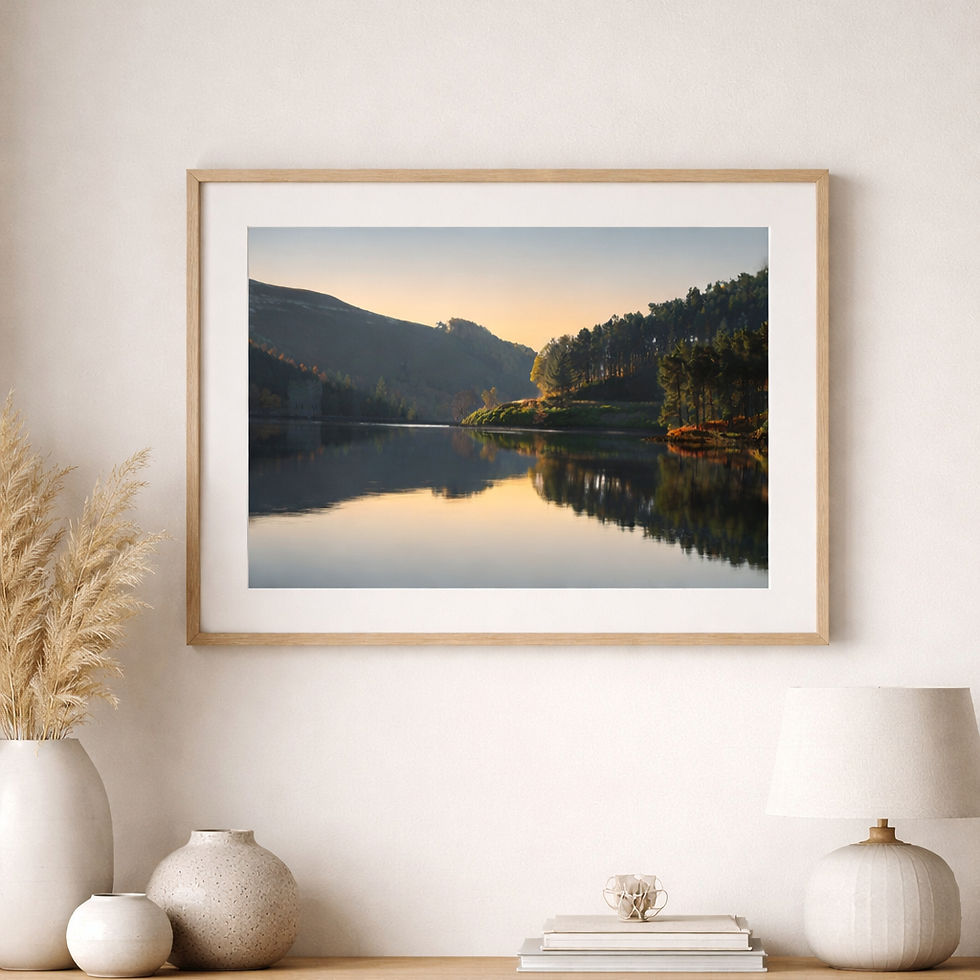
Quiet artwork can bring depth and atmosphere to a calm interior.
Nature is more than a subject
Nature appeared again and again this month.
Sometimes directly, through wildlife and landscape.
Sometimes through interiors, in posts about biophilic design and calm homes.
Sometimes through place, with the River Severn, gardens, trees, birds and local views.
I have always known that nature matters in my work, but writing about it daily made me see that it is not just a subject.
It is the thread that holds much of the work together.
A kingfisher is not only a bird.
It is a flash of impossible blue over water.
A robin is not only familiar.
It is presence, brightness and resilience.
A river is not only a view.
It is movement, reflection and return.
A tree is not only shape.
It is shelter, season and structure.
Nature gives artwork its emotional weather.
It can make a room feel softer, more grounded, more alive.
It can remind us of places beyond the walls, which is one reason biophilic art feels so relevant to modern homes.
Many of us spend so much time indoors that even a visual connection with birds, water, woodland or open sky can shift the mood of a space.

Place gives art roots
Writing about Shrewsbury reminded me how powerful place can be.
A local view is never just a local view to someone who knows it.
It can hold childhood, family walks, university years, market days, river crossings, remembered weather, favourite streets or the feeling of coming home.
Shrewsbury is especially rich in that way.
The River Severn, the Abbey, St Mary’s, St Chad’s, the Library, the castle, the Dingle and the old streets all carry different kinds of memory.
The town is layered with history, but it is also lived in.
That combination makes it visually and emotionally interesting.
For an artist, local places offer more than recognisable landmarks.
They offer atmosphere.
A familiar building in beautiful light can help people see it again.
A river scene can turn a daily walk into something quietly treasured.
A street or church can become a memory made visible.
This month reminded me that local work has real value.

Not because it is parochial, but because it is rooted.
Art rooted in place can hold memory, belonging and a sense of home.
My work has clearer themes than I realised
One unexpected benefit of writing every day was that patterns began to appear.
When you are close to your own work, it can feel scattered.
A bird here, a river there, a church, a flower, an abstract, a photograph, a digital piece, a painting.
But when I looked across the month, the same concerns kept returning.
Light emerging from dark.
Water and reflection.
Birds and wild creatures.
Soft skies and changing weather.
Historic places.
Natural forms.
Calm interiors.
Atmosphere.
A sense of quiet discovery.
That was encouraging.
It reminded me that a body of work does not have to be identical to be coherent.
The connection may be in the feeling, not just the subject.
A wildlife print, a Shrewsbury street, a river photograph and an abstract painting can all belong together if they share a similar attention to light, place, movement and mood.
That is something I want to carry forward.
Not to make everything match, but to make everything belong.
Different subjects can still belong together when they share light, mood and atmosphere.
Writing helps me see
There were days when the writing came easily, and days when it had to be coaxed out with a small net and a biscuit.
But even on the harder days, the process was useful.
Writing about art changes how I look at it.
It slows me down.
It makes me ask better questions.
What is this piece really about?
Why does this colour matter?
What kind of room would suit this work?
What feeling does it carry?
What problem might it solve for someone choosing art for their home?
It also helps me notice the gap between making something and helping someone understand it.
Artists often know, instinctively, why a piece matters to them.
But a viewer may need a doorway into that meaning.
A title, a short description, a blog post, a photograph in a room setting, or a note about process can all act as invitations.
Not explanations that pin the work down completely.
Just small openings.

Creativity needs rhythm more than perfection
Daily blogging also taught me something about rhythm.
Waiting until an idea is perfect is a very good way to never publish it.
A regular practice, even an imperfect one, creates movement.
One post suggests another.
A practical guide opens up a more reflective thought.
A photograph becomes a story.
A question becomes a useful article.
Not every post will be equally strong.
That is normal.
But each one adds something: a link, a phrase, a clearer idea, a better understanding of what readers might need.
For me, the useful part was not only the finished posts.
It was the act of showing up.
A creative practice needs space for experiments, half-formed thoughts, revisions and discoveries.
It needs a rhythm gentle enough to continue, but steady enough to build trust.
I may not continue blogging every day, but I do want to continue writing regularly.
Not as a separate task from the artwork, but as part of the same practice.
The making, photographing, writing and sharing all belong together.

The blog is becoming part of the art
At the beginning of the month, I thought of the blog mainly as a way to help people find my website and understand my work.
It still does that.
But now I also see it as part of the artwork’s wider life.
A print on a product page can show what something looks like.
A blog post can show where it belongs: in a room, in a memory, in a landscape, in a way of seeing.
It can connect a kingfisher to a river, a Shrewsbury view to a walk through town, an abstract to the feeling of water or weather.
That matters because art is not chosen in isolation.
It is chosen in relation to a life.
The blog gives me room to explore those relationships.
Art and interiors.
Art and nature.
Art and place.
Art and memory.
Art and the small decisions that turn a house into a home.
That feels worth continuing.

Looking ahead
This month has given me a clearer sense of direction.
I want to keep writing about art in a way that is useful, thoughtful and rooted in real homes.
I want to keep exploring nature-inspired work, local places, calm interiors, framing, scale, colour and the emotional reasons people choose art.
I also want to keep noticing.
That may be the most important thing.
Noticing the way light moves across a wall.
Noticing which birds return to the garden.
Noticing how a river changes with weather.
Noticing which artworks people pause over.
Noticing which questions keep coming up.
Art begins there, I think.
Not with grand statements, but with attention.
So this is not really the end of the blog.
It is the end of a month-long beginning.
There will be more posts, more artwork, more local places, more wildlife, more interiors, more colour, more questions, and almost certainly more moments where I wonder why I thought this was a sensible idea.
But for now, I am glad I did it.
It helped me see the work more clearly.
And I hope it has helped you find new ways to choose, enjoy and live with art.
✨ Thank you to everyone who joined in this edition of The Ultimate Blog Challenge.
I've loved reading your blogs and will keep dropping in. ✨


I have enjoyed your blogs this challenge. I especially liked Shrewsbury! Congratulations and looking forward to seeing you back in July!
Your writing throughout the month has had the same qualities you describe in your artwork: calm, atmospheric and full of quiet detail. This post tied everything together beautifully. Congratulations on finishing the challenge, Janice, and on building such a cohesive and engaging body of work.
A month of excellent posts. Congrats for being here every day this month. Your photos are beautiful, your writing thoughtful and detailed. Thanks for your inspirations.
Congrats on completeing the challenge. Your work is beautiful.
I agree - the challenge is about so much more than just writing everyday. For me it's about personal growth and community.
I look forward to seeing you in July.
I appreciate you sharing your thoughts on the subject of art and writing about it. I'm also an artist, and I love art, so I can relate to what you're saying.