Shrewsbury: A Town of River Light, Ancient Streets and Quiet Discoveries
Updated: Apr 29

Shrewsbury is a town that reveals itself slowly.
At first glance, it is all crooked streets, old stone, black-and-white timbered buildings and glimpses of the River Severn curling around it like a silver ribbon.
But spend a little longer here and the town begins to feel layered, part medieval market town, part riverside retreat, part place of learning, worship, trade and invention.
It is a town made for wandering.
Not rushing.
Not ticking things off.
Just following a lane because the light falls beautifully across a wall, turning a corner because a spire appears between rooftops, or pausing on a bridge because the river has caught the sky.
For artists, photographers, history lovers and slow travellers, Shrewsbury offers that rare thing: a town with texture.
A town held in the loop of the River Severn
One of the most distinctive things about Shrewsbury is the way the River Severn wraps around it. The old town sits inside a great loop of water, giving it a naturally sheltered, almost island-like quality.
The river changes the mood of Shrewsbury completely.
In the town centre, streets feel enclosed and historic, full of shopfronts, passages and old brickwork.
But walk a short distance and suddenly there is space: water, trees, reflections, rowing boats, bridges and long views.
The Severn gives Shrewsbury its softness.
It catches the changing weather, carries reflections of buildings and trees, and offers some of the most peaceful walks in town.
On still days, the river seems to hold the whole town upside down.

Streets full of character
Shrewsbury’s streets are one of its greatest pleasures.
Some are broad and busy, others narrow and tucked away, with a sense that they have held centuries of footsteps.
The town is known for its historic buildings, timber-framed fronts, old shop signs, cobbles, shuts and passages.
There are places where the angles feel slightly irregular, as though the buildings have settled comfortably into themselves over time.
This is part of Shrewsbury’s charm.
It does not feel overly polished.
It still has corners, oddities and unexpected views.
A doorway here, a carved detail there, a leaning upper storey, a sudden glimpse of church stone at the end of a lane.
These streets are ideal for photography because they reward attention.
The more slowly you look, the more they give you.

Looking down Fish Street towards St Julian's church 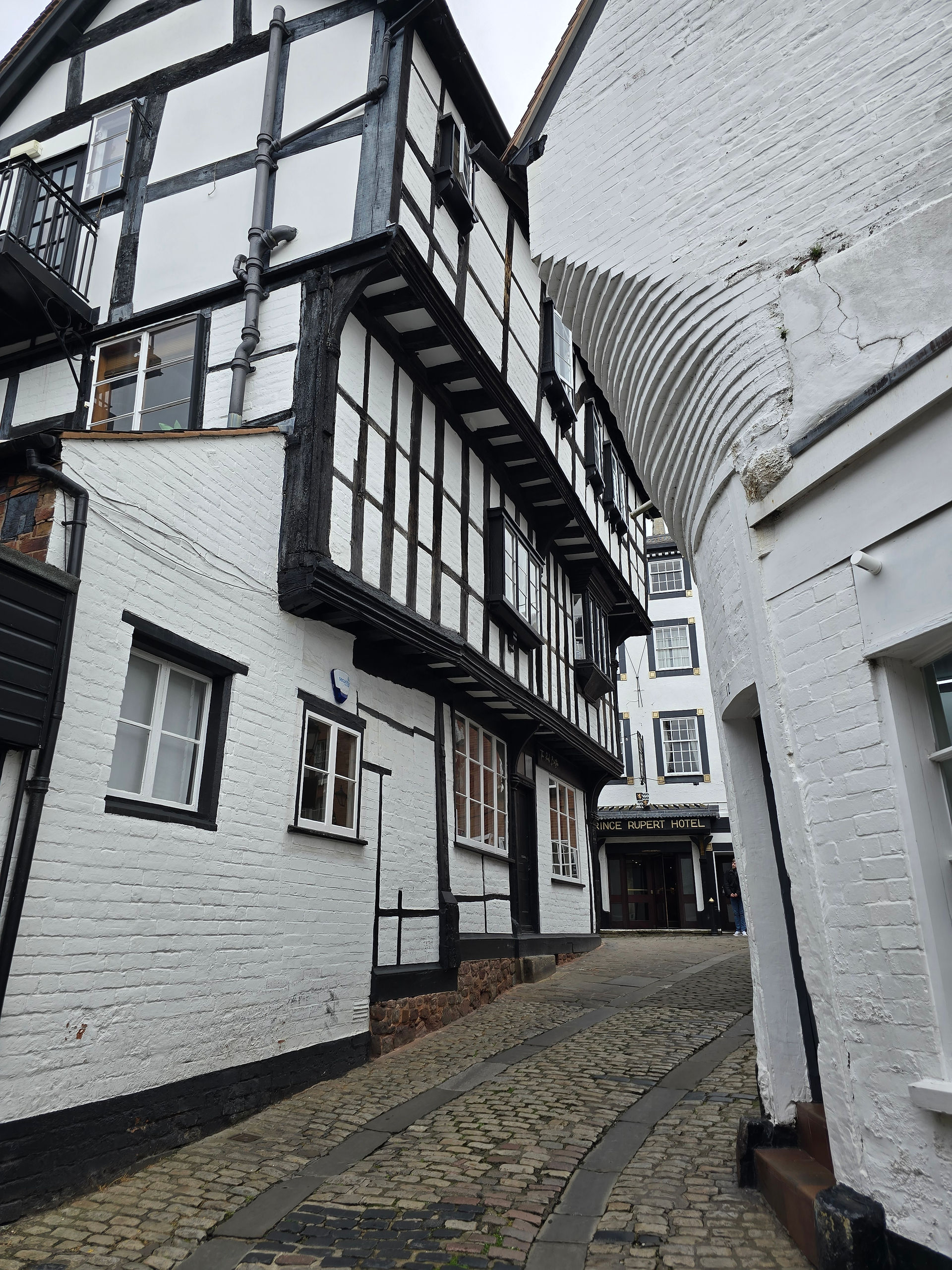
Tudor buildings overhang the cobbled street in this view towards Butcher Row. 
St Mary's Spire towers over the tudor buildings.
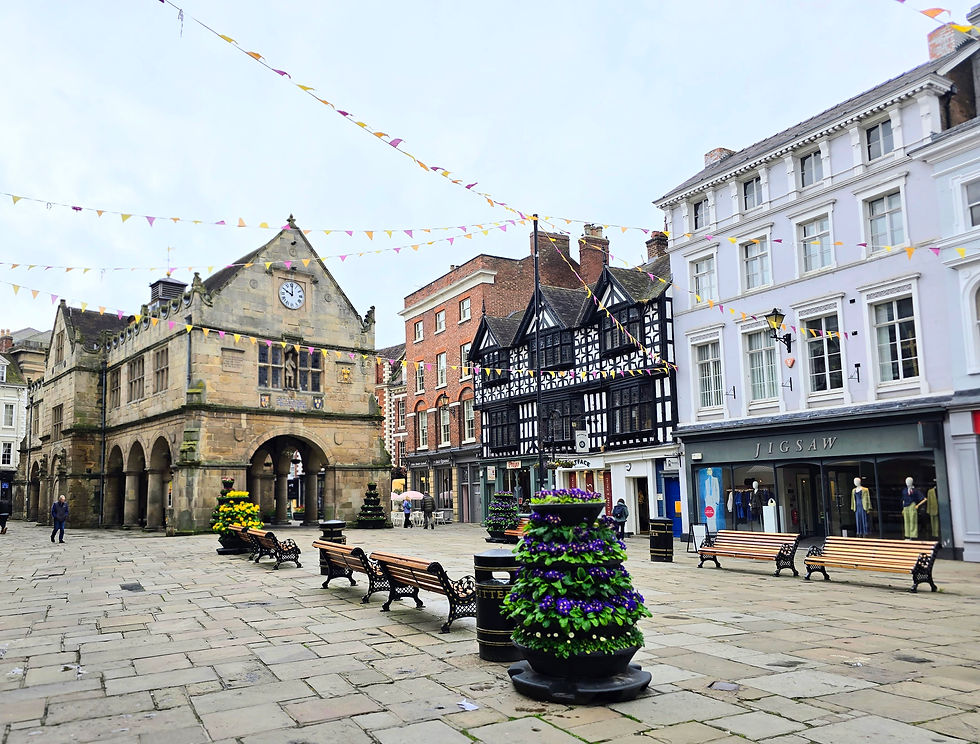
The Market Place: the town’s busy heart
The Market Place has long been one of Shrewsbury’s central gathering points. It is a place of movement, trade and conversation, surrounded by the architectural character that makes the town feel so distinctive.
Markets are part of the life of old towns.
They remind us that history is not only found in grand buildings, but in everyday exchanges: food, flowers, crafts, errands, meetings and the ordinary rhythm of local life.
In Shrewsbury, the Market Place links the historic town with the living town.
It is not simply a backdrop.
It is still part of the pulse.
Shrewsbury Library and the young Charles Darwin
No blog post about Shrewsbury would be complete without Charles Darwin.
Darwin was born in Shrewsbury in 1809, at The Mount, a house overlooking the River Severn.
Long before he became one of the most influential scientific thinkers in history, he was a Shrewsbury boy, growing up among the landscapes, gardens, riverbanks and natural details of this part of Shropshire.
Shrewsbury Library has its own Darwin connection too.
The building was once Shrewsbury School, where Darwin was educated as a boy.
It is fascinating to stand near the Library and think of the young Darwin before the voyage of the Beagle, before On the Origin of Species, before the great storm of ideas that would change how humanity understood life on Earth.
There is something quietly powerful about that.
A boy walks through a school doorway in a county town.
Years later, his observations help reshape science.
Perhaps that is one of the reasons Shrewsbury feels so rich: it contains both the ancient and the questioning mind.
Churches, castles and medieval streets sit alongside the memory of someone who looked at the natural world and asked deeper questions.

The Castle gate: a glimpse of Shrewsbury’s defensive past
Shrewsbury Castle sits above the town, a reminder that this peaceful-looking place was once strategically important.

Close to the Welsh border and held within the bend of the Severn, Shrewsbury had real defensive significance.
The castle gate gives a strong sense of arrival.
Gates always feel symbolic: a threshold between town and fortress, ordinary life and military history, the present day and something much older.
Even if you only glimpse the castle briefly, it adds another layer to Shrewsbury’s story.
This was never just a pretty market town. It was a place of power, protection and contested borders.
St Mary’s Church: elegance, glass and quiet height
St Mary’s Church is one of Shrewsbury’s most beautiful historic buildings. Its spire is a familiar part of the town’s skyline, and inside it has an atmosphere that feels both grand and intimate.
Historic churches often carry a town’s memory in a very particular way.
They hold craftsmanship, faith, local families, changing fashions in architecture and the quiet marks of time.
St Mary’s is especially known for its stained glass, which brings colour and radiance into the stone interior.
It is the kind of place where light becomes part of the architecture.
The windows do not simply decorate the building; they alter the feeling of the space.

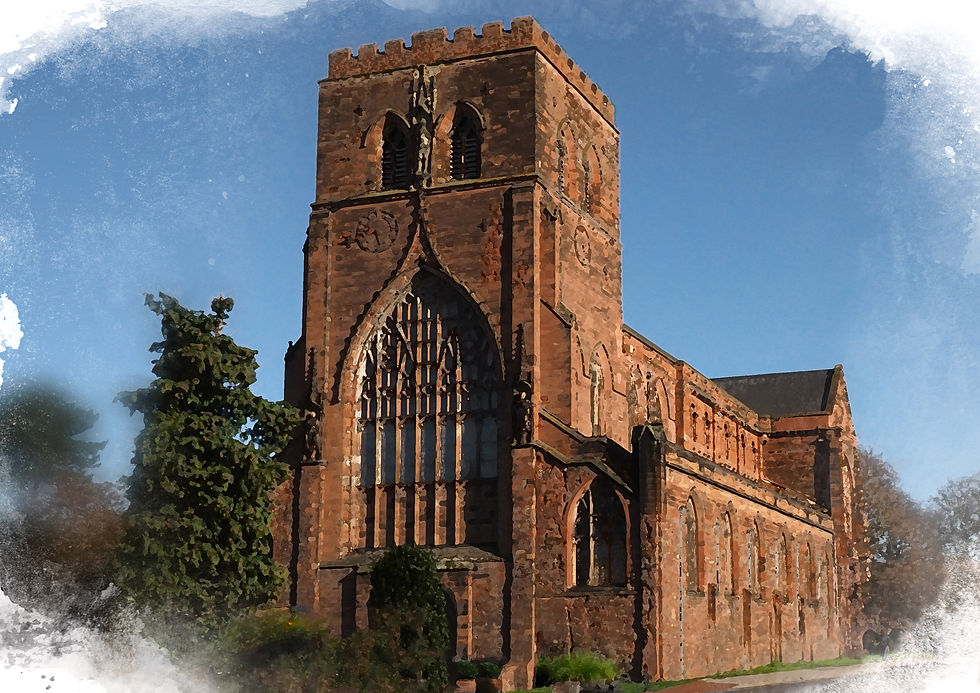
Shrewsbury Abbey: echoes of a monastic past
Shrewsbury Abbey is another of the town’s great historic landmarks.
Founded in the medieval period, it connects Shrewsbury with its religious and monastic past.
There is a solidity to the Abbey that feels different from the busy town centre.
It has a grounded, contemplative quality.
The stonework, arches and proportions speak of a time when religious buildings shaped not only worship, but education, charity, land, power and daily life.
For many visitors, the Abbey is also known through the fictional world of Brother Cadfael, the monk-detective created by Ellis Peters.
That literary connection has added another layer to the Abbey’s identity, blending real history with imagined medieval Shrewsbury.
St Chad’s: a landmark of grace and proportion
St Chad’s Church is instantly recognisable because of its distinctive round nave.
Set near the Quarry and the Dingle, it has an elegant presence and a strong sense of place.
It feels slightly different from some of Shrewsbury’s older medieval buildings.
There is something composed and graceful about it, a sense of order and calm. Its pale stone, rounded form and position near green space make it one of the town’s most photogenic landmarks.
St Chad’s also acts as a kind of hinge between the built town and the natural beauty of the Quarry.
From here, Shrewsbury begins to open out.

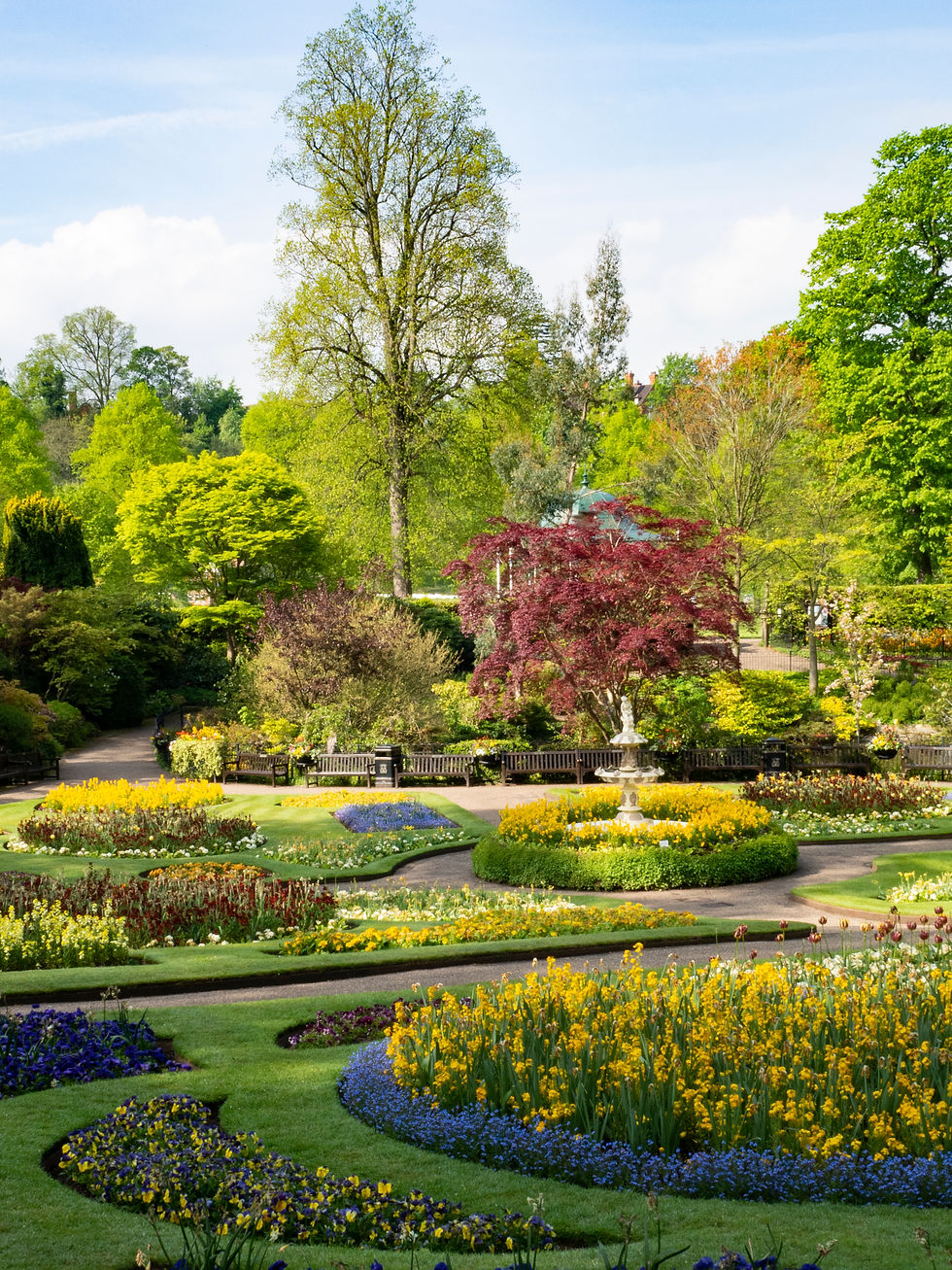
The Dingle: a garden tucked inside the town
The Dingle is one of Shrewsbury’s small treasures.
Set within the Quarry park, it is a beautifully planted sunken garden, full of colour, texture and seasonal change.
It offers a different kind of beauty from the town’s churches and historic streets.
Here the appeal is softer: flowers, water, foliage, curved paths and carefully framed views.
It is a place to pause rather than pass through.
For artists and photographers, the Dingle is full of possibilities.
Spring blossom, summer planting, autumn colour, reflections, shadows, leaves after rain.
It is intimate enough to feel enclosed, but rich enough to reward repeated visits.
The Dingle also shows something important about Shrewsbury: nature is never very far away.
Even in the heart of town, there is green space, river light and birdsong.
Why Shrewsbury stays with you
Shrewsbury is not a town that depends on one famous landmark. Its beauty comes from accumulation.
A street.
A spire.
A market square.
A castle gate.
A river bend.
A garden.
A church window.
A library doorway with a connection to a boy who would one day change science.
It is this layering that makes Shrewsbury so rewarding. The town does not shout. It invites you to notice.
For me, Shrewsbury is a place of textures and transitions: stone into water, history into daily life, town into garden, science into wonder.
It has grandeur, but also intimacy.
It has famous names, but also quiet corners.
It is a place where a camera never feels out of place, because there is always another angle, another reflection, another small piece of beauty waiting to be found.
And perhaps that is the real charm of Shrewsbury.
It reminds us that discovery does not always begin in faraway places.
Sometimes it begins close to home, in familiar streets, beside a river, under an old spire, looking again.


Stunning! It sounds like the kind of place I would love to explore at length.
Beautiful photos, much history and texture. Thanks for sharing.
I had to look up on the map where Shrewsbury is. You’ve really captured the atmosphere, sounds like a lovely place to visit
I love old towns like this, the stone streets, the beautiful buildings and the peacefulness. I could picture me strolling down the street as I was reading your blog Janice! Your photos are exquisite and such colorful flowers and trees. Thanks for taking me on your tour!
I appreciate you sharing your thoughts about the town of Shrewsbury. I enjoyed looking at the photos. I especially liked the garden, as I always love the beauty of nature.