Miles Away: How I Created a Dreamlike Digital Composite from Five Photographs
- Janice Gill
- Apr 16
- 5 min read

Some images arrive all at once.
Others gather themselves slowly, over years, like fragments of a dream waiting to be recognised.
Miles Away has been one of my most popular imagined works, especially as a canvas print, and I think part of its appeal lies in that feeling of quiet escape.
It seems to speak to something many of us know: the wish to step beyond the visible world for a moment, to drift into thought, memory, or possibility.
For me, this image is about distance in every sense, distance in time, in place, and in the private landscapes of the mind.
Although the finished piece was created digitally, its roots lie in techniques I learned long ago while working with film photography.
The tools are different now, smoother and more forgiving, but the instinct is much the same.
It is still a process of gathering separate moments and persuading them to belong to one world.
The Starting Images
This digital composite began with five photographs, taken across seven years.
Four are my own images, made between 2017 and 2024, and the fifth, the planet Neptune, is a NASA image made available free through Unsplash.
The source images are:
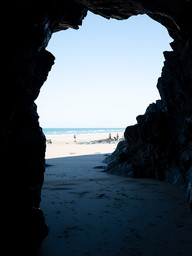
The Cave (2024) - The setting that became the frame for the imagined world.
Girl on Rock (2017) - The quiet human presence at the heart of the composition.
Aurora (2020) - Colour, atmosphere and a touch of the unreal.
Hovering Kestrel (2019) - A final note of movement, freedom and watchfulness.
Neptune (NASA) - A distant world that shifted the image from memory into dream.
Each image began with its own purpose, its own weather, its own light. None of them were originally connected.
Yet when brought together, they seemed to recognise one another.



How Composite Images Were Made in the Film Era
Long before digital layers and masks, composite images were often made by hand in what was quite literally a process of cut and paste.
In the film era, photographers and artists would create physical prints in the darkroom, often testing different sizes and tonal variations first.
Sections of those prints could then be cut out with a scalpel or craft knife and arranged on board by hand.
One element might be moved slightly to the left, another trimmed more closely, another replaced entirely.
The composition evolved physically, piece by piece, under the artist’s eye.
Once the arrangement worked, the joins could be disguised with retouching, using pencil, paint, or airbrush, or the whole composite might be re-photographed to create a new negative from which a final print could be made.
It was delicate, painstaking work.
Scale had to be judged by eye.
Edges had to be softened manually.
Light and contrast had to be coaxed into harmony.
There was very little room for error.
Digital processing has transformed that workflow. Now I can work with far greater control, adjusting and refining without damaging the original image beneath.
But the heart of the method remains the same: selecting, combining, concealing, revealing, and balancing separate elements until they speak as one.
How I Built Miles Away

I will not get too technical here, but the process begins by creating a separate layer for each photograph. Working in layers allows me to move, resize, and fine-tune each element independently while keeping the whole composition flexible.
From there, I mask the areas of each image that will be used in the final piece, gradually revealing only what belongs. This is where the picture begins to shift from a set of photographs into something more atmospheric and suggestive.
To create the dark forms and silhouettes, I use techniques such as dodging, burning, and underexposing, shaping the balance of light and shadow so the image feels coherent.
Gradients are then used to help unify the different components, blending their tones and colours so that the final scene feels held within a single world.
Composition matters just as much as technique.
The cave creates a natural frame, almost like a threshold between one reality and another. The girl sits quietly within that opening, giving the viewer a human presence and a point of stillness.
Neptune holds the upper corner, preventing the eye from drifting away, while the kestrel introduces movement and a feeling of freedom.
Together, these elements create a visual rhythm: shelter, stillness, distance, flight.
Little by little, the image becomes less a collection of photographs and more a place.
Final Processing
Once I am satisfied that all the elements are working together, I flatten the image, remove any dust spots or imperfections, and export the finished piece as a JPEG.
It sounds like a simple ending, but really it is the final quiet act in a much longer process. By then, the technical work is almost done, and what remains is judgement: does the image hold together, and does it still carry the feeling that first stirred it into life?
The Inspiration Behind Miles Away
You may wonder what inspired this image, and what it means.
The first seed was planted many years ago when I was at school. In an art lesson, I was asked to design a book cover for Far from the Madding Crowd. I painted a girl sitting beneath a tree on a hill, reading a book.
It was only a small exercise, but the image stayed with me long after the lesson had passed. There was something in that solitary figure, lost in thought, that remained unfinished in my mind.
Years later, while standing in a cave and looking out across a beach in Cardigan Bay, Wales, the idea returned in another form. The cave felt like a threshold, a place between shelter and openness, darkness and light. Looking out from there, it was easy to imagine someone seated at the edge of another world.
Once home, I began searching through my catalogue of photographs.
The girl on the rock came first, another beach image, taken at Llangrannog Bay.
The aurora followed, bringing with it those strange, mystical colours that seemed to belong to a dream rather than the everyday sky.
I wanted something in the upper corner to stop the eye moving out of the image, and Neptune proved perfect: blue, distant, mysterious, suggestive of somewhere far beyond reach.
At that point, the meaning of the image began to deepen. My figure was no longer simply resting.
She seemed to be dreaming, or wandering inward, lost in a private universe of thought. The kestrel came last, and with it a new note entered the piece: freedom, watchfulness, the possibility of movement through silence and space.
I named it Miles Away.
Miles away in thought, perhaps.
Miles away in distance.
Miles away on another planet.
I will leave that for the viewer to decide.
Why This Image Connects with People
I suspect this image has resonated with people because it leaves room for them to enter it with their own story.
It is not tied to one fixed narrative.
Instead, it offers a mood: solitude, wonder, escape, longing, imagination.
The figure is turned away from us, which makes her less a portrait of one person and more a place-holder for anyone who has ever felt far away while standing still.
Perhaps that is why it works so well as a canvas print. The image has space in it, both visually and emotionally. It invites the eye to wander and the mind to follow.
Closing Thoughts
What I love about this kind of work is that it allows photographs taken years apart, in entirely different places and circumstances, to find their way into conversation with one another.
A cave in Wales, a girl on a rock, an aurora, a kestrel, a distant planet: none of these belonged together in reality, yet together they became Miles Away.
That, to me, is part of the magic of composites. They do not simply record the world as it is. They offer a way of building the world as it feels.
I hope this gives a small glimpse into how imagined images are made, and how separate moments, gathered over time, can sometimes come together to create something new.


The image reminds me of the song, The Canyons of Your Mind. Your photography is beautiful. It must be awesome to be able to create so.